Manual
Molecular build 75 for the Sonicake Pocket Master.
The controls
The Pocket Master has an encoder (turn and press) and two side buttons. A hold means 0.8 seconds. The side buttons act when they are let go, or once held for 0.8 seconds.
| Control | On the molecule | In the menu |
|---|---|---|
| Encoder, turn | Volume, shown large | The next item, slot or value |
| Encoder, press | A new molecule | Does the item; in PATCHES, loads the slot |
| Encoder, hold | Opens the menu | Back to the molecule; in PATCHES, saves to the slot |
| Left button | Rewires the molecule | In PATCHES or SETTINGS: back |
| Left button, hold | New LFOs for the generator and every atom | - |
| Right button | New values for every atom | In PATCHES or SETTINGS: back |
| Right button, hold | MOTION on or off | - |
| Both side buttons, 3 s | The pedal's update mode, for an install (see Update mode) | |
Powering on and off
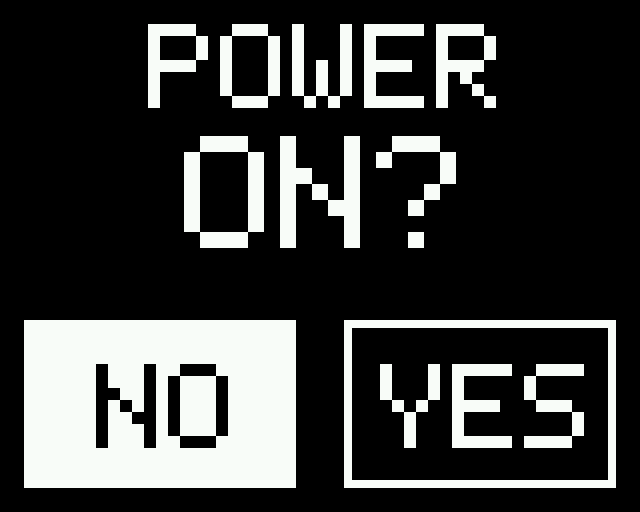
Hold the encoder to switch the pedal on. The screen asks POWER ON? with NO and YES, NO first: turn to YES and press. NO, or no answer for 10 seconds, switches it off again. Letting go of the hold that switched it on answers nothing.
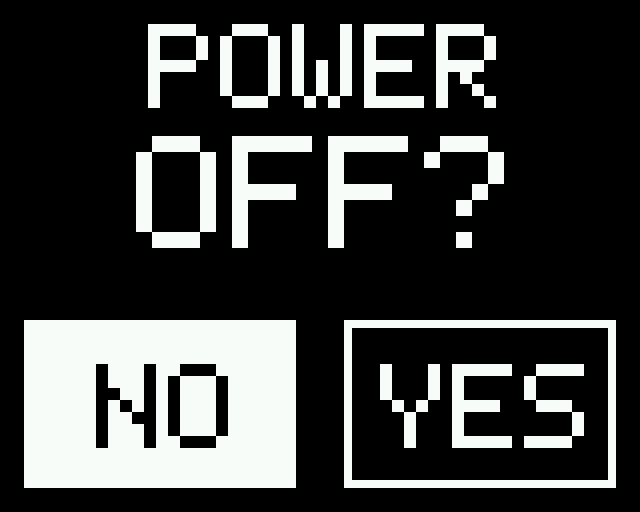
To switch off, open the menu, choose POWER and answer YES to POWER OFF?. The sound fades, the screen says OFF, and the pedal switches off. Connected to a computer by USB the pedal stays powered, its screen dark and silent; hold the encoder to start it again.
The molecule
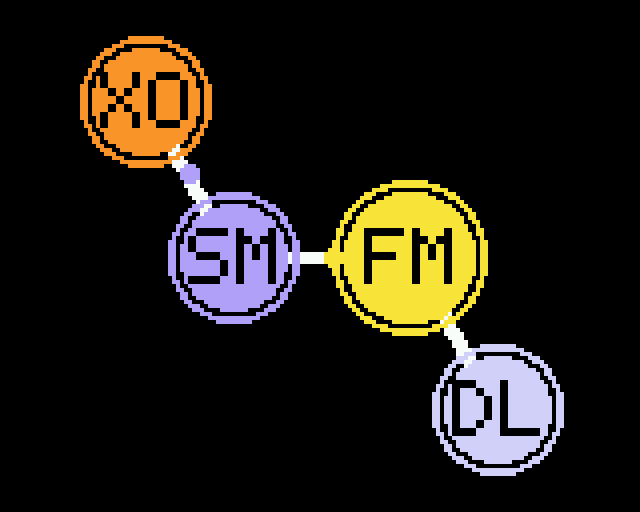
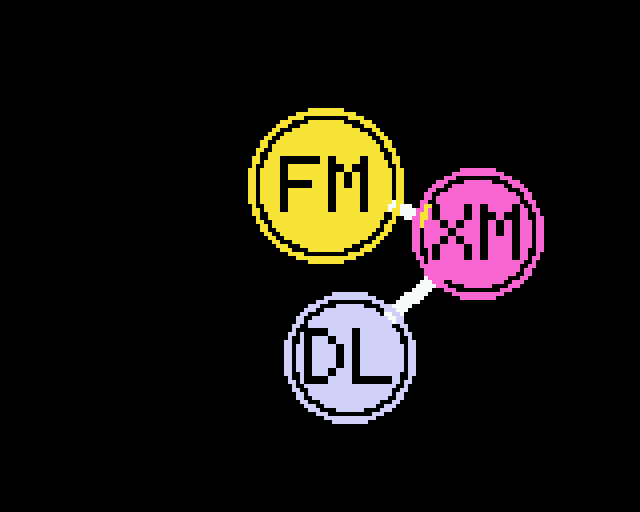
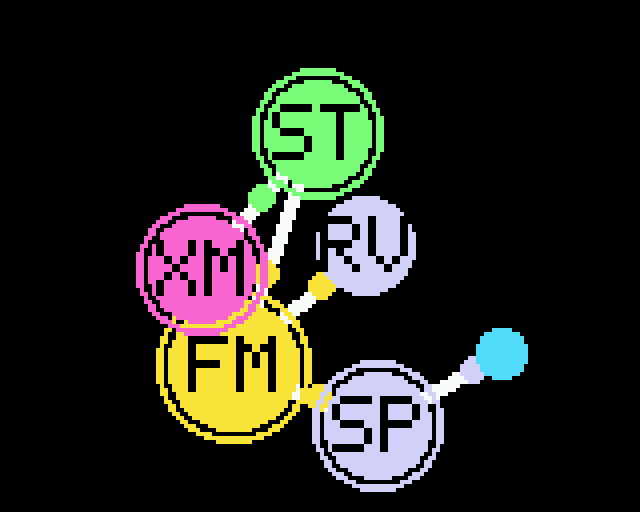
Every sound is a molecule, drawn as a chemist draws one: the generator, a large yellow disc marked FM, bonded to one to five atoms, each an effect, in the colour of its family. Each atom takes the sound of the atom it is bonded to on the generator's side. The outermost atoms are heard, each where it stands across the screen, from left to right in the stereo field. Half of what you hear is the generator itself, in the middle; the other half is the atoms.
A ring lights round each disc while it sounds, and small dots travel along the bonds, larger when louder. A new molecule shows its generator's family for a moment.
- Encoder press: a whole new molecule, generator and atoms, through a short fade.
- Left button: the same atoms, with their values and LFOs, bonded anew (REWIRE). Some molecules can be bonded only one way, and say NO REWIRE. The sound crossfades to the new bonds.
- Right button: every atom's values drawn anew (FX). The kinds and the bonds stay. With FX MORPH set (SETTINGS), the values glide to the new ones over that many seconds instead of changing at once.
- Left button held: new LFOs for the generator's four macros and for one value of each atom (LFO).

The generator
Two engines: six-operator FM and physical models. Each new molecule draws one of 66 families, a chord to play it on, and, for FM, four LFOs on its macros. A new molecule is never of the family of the last three, and often of another kind, so successive sounds contrast.
- Ambient
- Tonitor's families, drawn on its ambient path: METAL, DRONE, ITERATIF, SPECTRE, ABYSS, CHOIR, BOWED, HOLLOW, BLOOM, TIDE, WIND, PLUCK, MALLET, WARP, SHAPER, LADDER, REVERSE, CREEP, CLANG.
- Harsh
- Tonitor's harsher families, on its open path: BRUIT, FRICTION, SHARDS, STATIC, GLITCH.
- Held
- Recipes after Norilsk's: HUM (a machine room), SWARM (a buzzing mass), ORGAN (an organ in a ruin), MODES (metal in the wind), STEAM (a hissing pipe), SCRAPE, CORONA (a high shimmer), ASH (a dark drone under a dusty crackle).
- Struck
- Metal struck, never a drum, on clocks that never quite repeat: ANVIL, STAMP, RIVET and SHEET scatter their strikes in clusters and pauses; GEARS, PISTON, RATCHET and FORGE run like machines whose pace wanders, some with a hiss of steam between strikes.
- From the FM literature
- TRUAX (one set of partials, its energy moving: Truax's normal forms), HAMMER (Schottstaedt's piano), TAM (tam-tams and membranes), CHIME (Chowning's tubular bell, with its hum below the note), FORMANT (the chord fused in fixed resonances), GROWL (feedback through a chain of operators), GLOW (brightening as it dies), ALLURE (the timbre pulsing at 3 to 12 Hz).
- Physical models
- HARP (a plucked string), WIRE (a stiff struck wire, its partials stretched), SNARE (Karplus-Strong's drum), PIPE (a struck stopped pipe), SITAR (a buzzing bridge), GONG (stiff, its pitch falling as it dies), BOWL (banded waveguides: bars, glass, a Tibetan bowl), BAR (marimba, vibraphone, agogo, wood), BELL, SKIN (a membrane). Struck on the same clocks, or held by a dust of small strikes.
The atoms
Each atom is one effect, its colour its family: cyan for filters and formants, orange for drive and wave shaping, pink for frequency shifting and cross-modulation, green for resonators, violet for time and texture, pale blue for space. Every atom has four values, drawn within bounds where it is always heard.
Motion
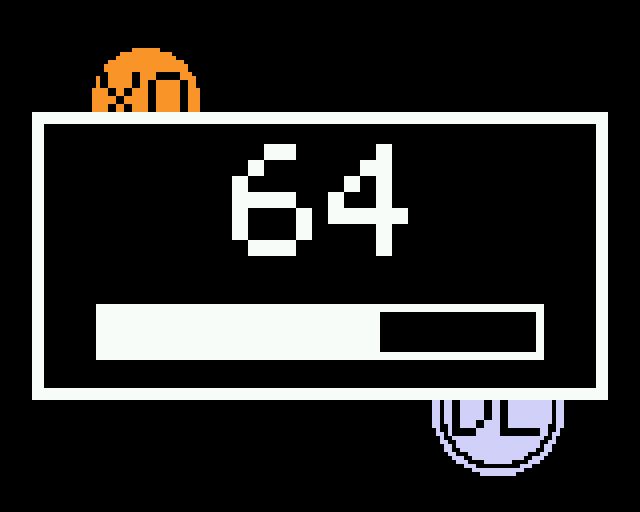
Hold the right button: the screen says MOTION, and the molecule starts to move by itself. Hold it again to stop it (STILL); the molecule stays as it is then. Motion is the molecule doing what molecules do.
- Thermal motion
- Every disc drifts on a path that turns smoothly. Bonds stretch and pull like springs towards their length, discs that come too close push each other away, and the screen's edges turn them back. Each atom's place across the screen is its place in the stereo field.
- Rearrangements
- At the patch's motion rate, one event, drawn at random:
- rewired (two in eight): the same atoms bond anew, each where it stands; the new bonds draw them together over a second or two, and each atom's sound crossfades from its old source to its new one;
- an atom grown (two in eight): a new atom appears beside the atom it bonds to and swells into the molecule, its sound coming in dry and turning wet;
- an atom pruned (one in eight): an outermost atom shrinks away, its sound turning dry and leaving the mix, and then it goes (never the last atom);
- new values (three in eight): one atom's values glide to new ones, over the whole time until the next event.
- The generator
- Never touched: it is the voice, and the molecule goes on searching around it.
Nothing jumps: nothing is faded out or restarted, and the sound is a continuum. Only the values that can move smoothly glide; switches, such as a filter's type, keep what they are. The drift's pace follows the motion rate too: faster at a higher rate.
A patch saved while moving keeps the molecule as it was at that moment. The encoder press still draws a new molecule, and motion goes on with it.
The menu
Hold the encoder on the molecule. One item at a time, its colour round the screen: SETTINGS, PATCHES, POWER. Turn for the next, press to choose, hold to go back. The molecule goes on sounding. The menu opens on the item you last went into, so after using PATCHES once, hold and press takes you straight back to the slots.
Settings
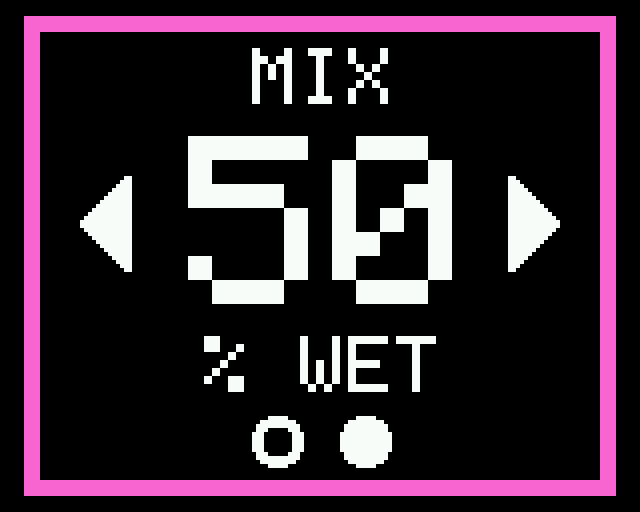
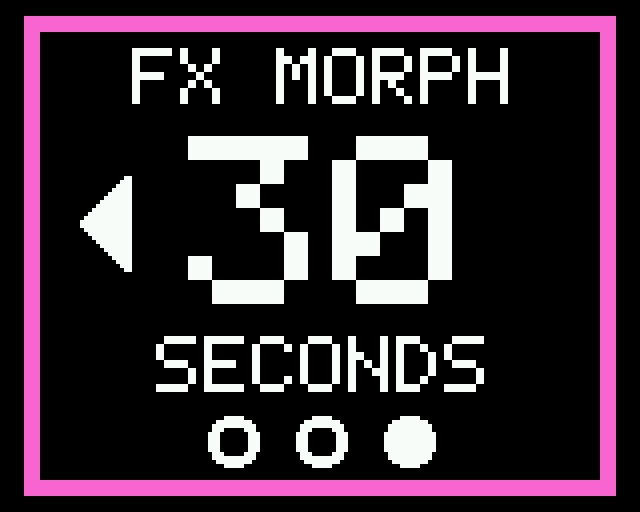
The patch's own settings, saved with it, one a page; the dots below say which. Turn to change the value; the arrows show which way it can go. A press goes to the next page (after the last, back to the molecule); a hold or a side button goes back. A new molecule keeps what you set; a loaded patch brings its own.
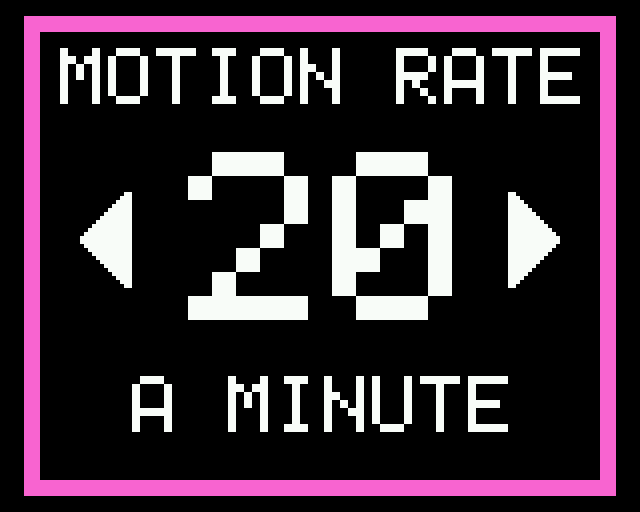
- MOTION RATE: motion's events a minute, 6, 10, 15, 20, 30, 45, 67, 90 or 120 (20 to begin with).
- MIX: how much of the sound is the effects, 0 to 100 % in steps of 5 (50 to begin with). At 0 only the generator is heard; at 100 only the atoms.
- FX MORPH: how long the right button's new values take to arrive, 0 to 30 seconds, one second a step (0 to begin with: at once). Values that move smoothly, such as a filter's frequency, glide all the way; switches, such as a filter's type, change halfway through. A new molecule or a loaded patch ends a glide.
Patches
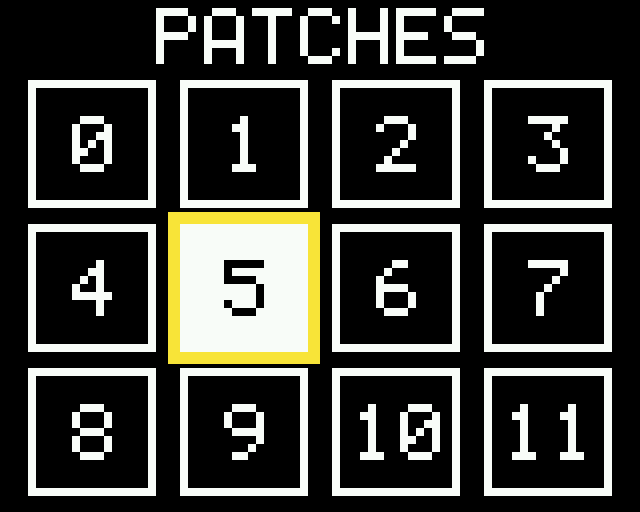
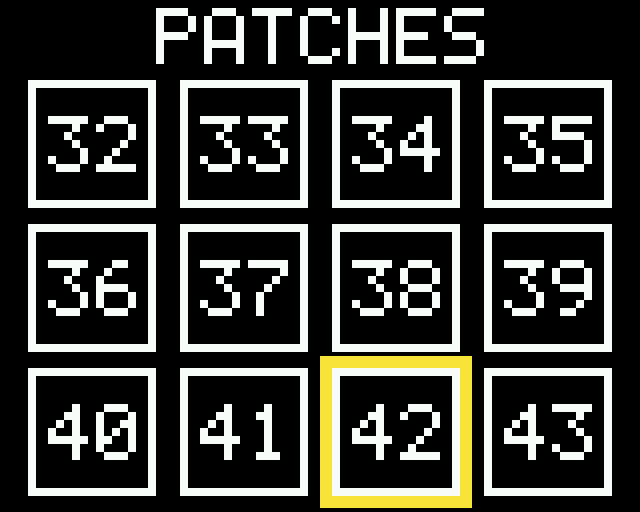
A hundred slots, numbered 0 to 99, four a row, three rows on the screen; turning past the bottom row scrolls on. An empty slot is outlined; a filled one is solid white; the chosen one is ringed in yellow. Turn to choose a slot. The slots open on the one you chose last.
- Press: loads the slot's patch (LOADED 5). An empty slot says EMPTY 5, and the slots stay open.
- Hold: saves the molecule there as it sounds now: its shape, its atoms' values and LFOs, the generator's patch, chord and clock, and its settings (SAVED 5). A filled slot is written over.
- A side button: back to the molecule.
Patches are kept in the pedal's flash and survive switching off and installing a newer Molecular. The twelve slots of build 74 and earlier are now slots 0 to 11, with their patches in them. A save cut short by the power is completed the next time the pedal starts, and never harms the other slots.
Power
POWER OFF?, NO first. YES switches the pedal off; NO goes back to the molecule, still sounding.
What the screen says
| Word | Means |
|---|---|
| a family's name | A new molecule: its generator's family |
| REWIRE / NO REWIRE | The left button: bonded anew, or there was no other way to bond these atoms |
| FX | The right button: every atom's values drawn anew |
| LFO | The left button held: new LFOs |
| MOTION / STILL | The right button held: motion on, motion off |
| LOADED 5 / EMPTY 5 | A slot loaded, or nothing there |
| SAVED 5 / FAILED 5 | The molecule saved to a slot, or the save did not verify |
Update mode
The install page puts the pedal in its update mode by itself. To do it by hand, hold both side buttons for 3 seconds while Molecular runs. The screen goes dark and the pedal waits for an install. Switching it off leaves update mode: the next start is Molecular again, unchanged.