Amalthea is not an app on top of the stock firmware. It replaces the Brick's operating system with
Amalthea Linux, a minimal distribution built for one purpose: a platform for musical instruments, running
them with the lowest latency and the steadiest audio the hardware allows. The gaming frontend, the emulators and the rest of the stock
system are gone, and nothing else competes for the processor.
Amalthea nursed Zeus; in the tradition where she is the goat herself, one of her horns became the cornucopia,
the horn of plenty. Amalthea is also Jupiter's red moon. The platform offers plenty: synthesis engines, more
than seventy effects, generators and a master chain, shared by every instrument and used by each in its own way.
New instruments arrive with new builds.
Amalthea is built to host a growing fleet of instruments. Underneath all of them sit the same resources: the
synthesis engines, the effects, the generators, the master chain, the session banks and the audio and USB stack.
Each instrument puts them to a different use: one sequences the engines, another runs effects over external audio,
another grows networks of effects. New instruments arrive with new builds, and the installer adds them in place.
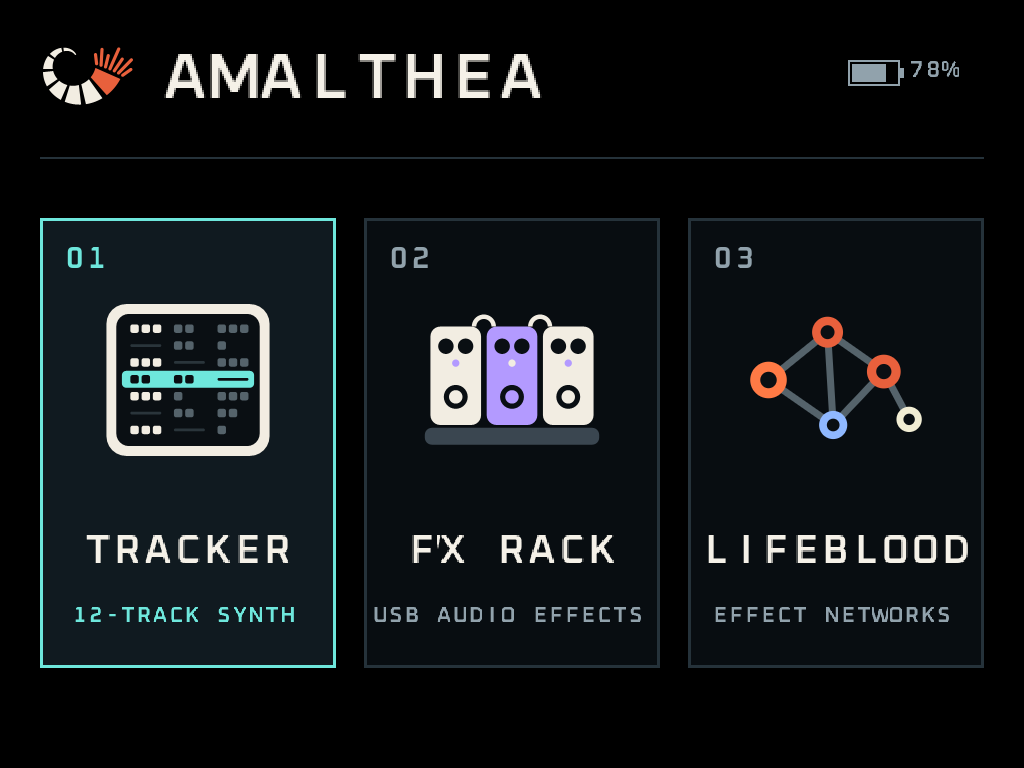
On the platform today
Choose an instrument on the home screen. Every one starts blank and stopped; nothing is saved or recalled behind
your back.
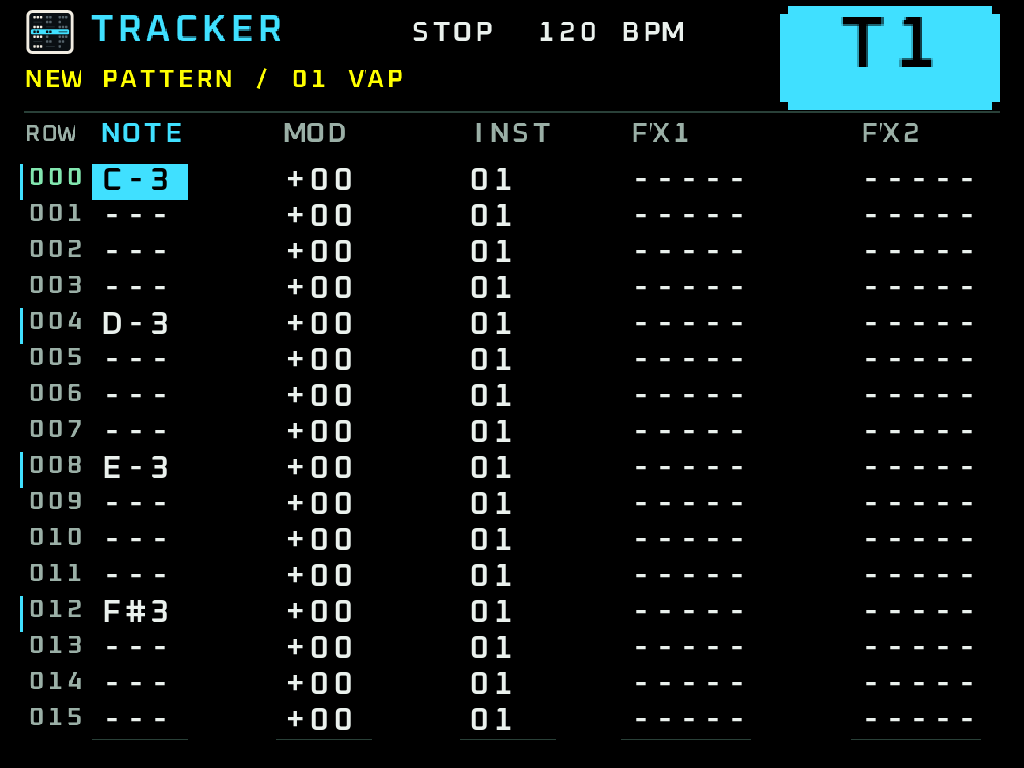
Tracker
Twelve tracks of fifteen instruments each, with five independently clocked columns (NOTE, MOD, INST, FX1,
FX2), 19 playback directions, a condition for every parameter of a step, per-step effects, transposition and
random redraws. Hold X and any column is drawn for you, at random or euclidean, at the density you choose, in
38 scales. PERFORMANCE mode plays effect chains and LFOs over the pattern without touching it.
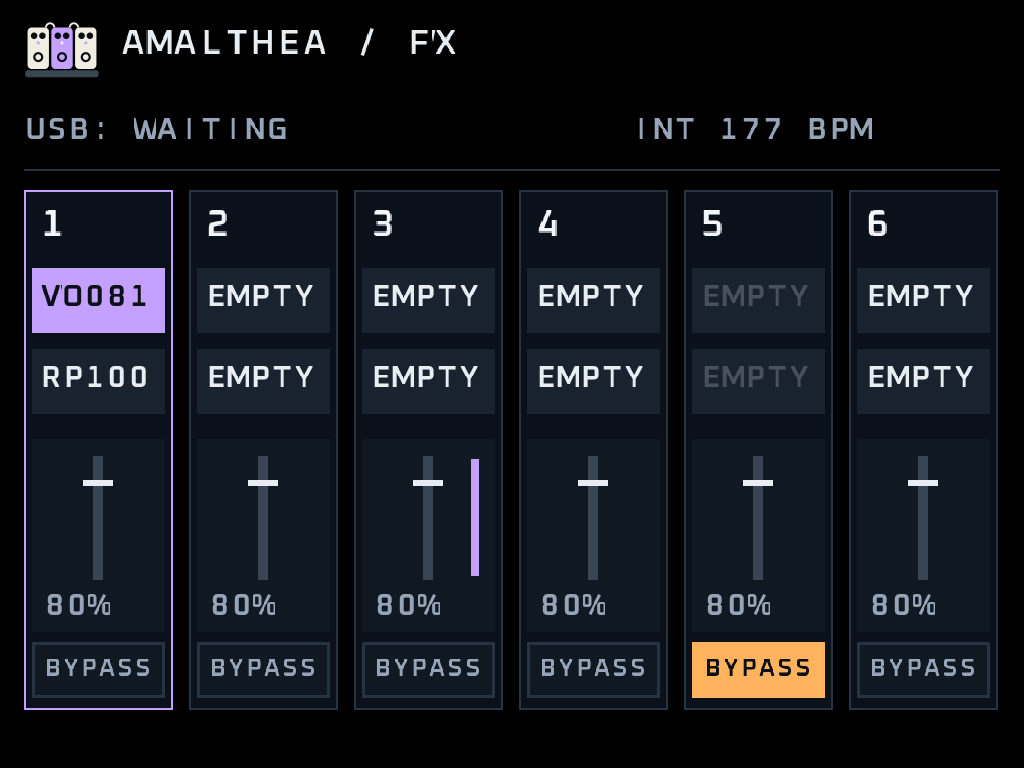
FX Rack
An effect rack for the M-VAVE FM-1's multitrack USB audio. Each of its tracks runs through two inserts, and
each insert has a 16-step sequencer of parameter locks, clocked by the FM-1.
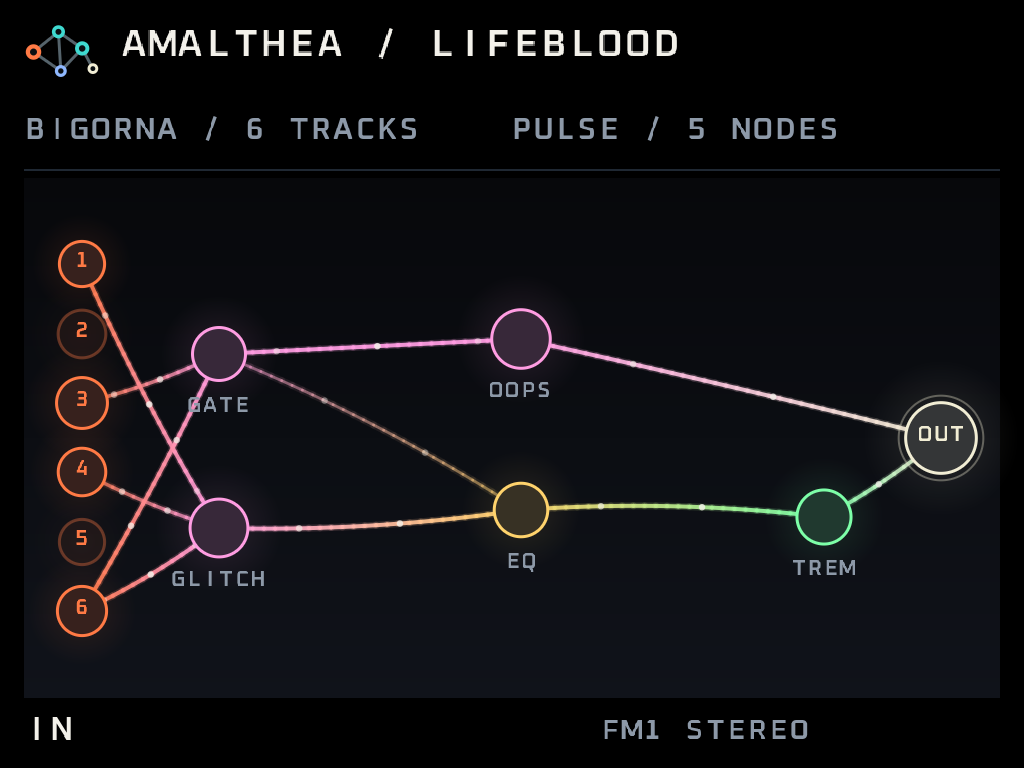
Lifeblood
The FM-1's tracks through a generated network of effects, drawn as a living vascular field. Grow it from a
recipe, rewire it, and let it mutate on its own. Each track keeps the place the FM-1 pans it, and every
synced effect follows the FM-1's clock. A mastering stage, a 10-band EQ into a bus compressor, has profiles for
power noise, rhythmic noise, industrial techno, dark synthwave, dark ambient, acousmatic and textural work.
Why a whole operating system
The stock firmware is a gaming system: a frontend, a service manager, networking, Bluetooth, an overlay
filesystem and dozens of background processes. An audio engine must deliver a block every 5.8 milliseconds, and
every one of those processes competes with it. We were after the greatest optimisation possible, and that meant
owning the whole userspace. Amalthea Linux keeps only what the hardware needs from the stock firmware, and builds
everything else itself.
Amalthea: Tracker · FX RACK · LIFEBLOODframebuffer and ALSA, no UI framework
Supervisor: blank, stopped start; restart on failure
BusyBox init, built from source; read-only root (13 MB)
The same board helpers
Boot manager and RAM recoveryverifies by SHA-256, never boots a half-written system
The same kernel, bootloader and partition table
Shared resources
Fifteen engines
VAP, PERC, CHIP, FIBER, HIVE, OP4, ANIMA, RUSSOLO, BAY AREA, RESURGENT, CALIGULA, FM
DRUM, OBRADOR, and Mutable Instruments' RINGS and PLAITS. In the Tracker, each track has its own fifteen sounds.
Generators
Melodic idioms, drum patterns, euclidean rhythms, sounds, effects and their parameters,
drawn with X at the density you set; fresh entropy on every start. FUNC + hold X gives every step its own
variation of its instrument's sound, with the pitch untouched.
Inserts
More than seventy, shared by every instrument: drives and destruction, filters, delays,
reverbs, granular, resonators, cuts and repeats, spectral effects, vocoders. Values in real units.
Master
ABRASION, CORROSION, MODULATION, compressor, delay and reverb, with sends from every track.
Banks
Every instrument has its own bank of 64 sessions (the Tracker with 32 patterns per session,
LIFEBLOOD with 32 snapshots). Saved only when you save.
FM-1 host
The Brick powers and hosts an M-VAVE FM-1 over USB-C: Bigorna, Tonitor and Lilliput's six
tracks, Norilsk's three, and the FM-1's MIDI clock.
USB audio out
Plugged into a computer or phone, the Brick is a class-compliant stereo audio input.
Recovery
A USB recovery shell in RAM, and a one-command return to the stock system.
Read before installing. Amalthea replaces the Brick's operating system. You install it at your
own risk, with no warranty of any kind. The installer saves the stock system on your computer first, and the
restore script puts it back. Installation guide.